As an Amazon Associate this site earns from qualifying purchases.
Specifications
| Product | Brand | Stated width | Stated seat depth | Configuration | Price |
|---|---|---|---|---|---|
| GRUSIGN Cloud Sectional (Black) | GRUSIGN | Not stated | Deep seat (not stated) | 3-seater L-shape, right-facing chaise, 2 boxes | Check price on Amazon |
| Lakifun 96" Modular Sectional | Lakifun | 96" | Deep seat (not stated) | 2-piece L-shape, right-facing chaise | Check price on Amazon |
| Eafurn 96" Modular Sectional | Eafurn | 96" | 51" | 2-piece modular, reversible chaise | Check price on Amazon |
| Korser 108" L-Shaped Modular Sectional | Korser | 108" | 30.08" (14" seat height) | 3-piece modular, chaise | Check price on Amazon |
| THSUPER 96" Black Oversized Sectional | THSUPER | 96" | 27" | 2-piece modular, right-face chaise | Check price on Amazon |
| Mangodan Cloud Sectional (Dark Grey) | Mangodan | Not stated | Wide, deep (not stated) | Modular L-shape chaise | Check price on Amazon |
Quick answer: Measure your room first, then shop — a sectional should leave at least 30 inches of walking space around it and cover no more than about two-thirds of the wall it sits against. For most living rooms, that means a 96" to 108" L-shape; in a 12x12 room, stay at or under 96" and put the chaise on the side away from your main walking path. Everything else — fabric, foam, chaise orientation — is secondary to getting the footprint right.
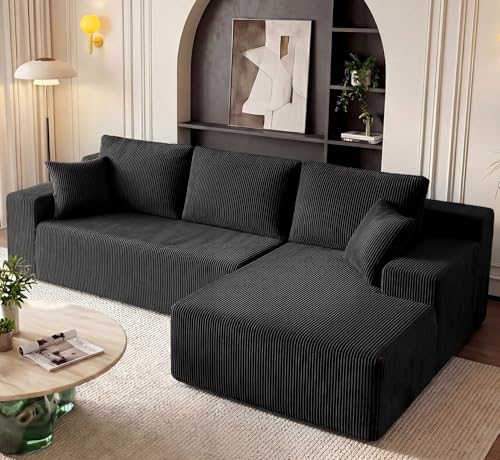
- Cloud-Like Comfort: Featuring 3D cutting technology, the memory foam sofa is filled with 30D elastic foam, providing excellent support and resilience for a more comfortable
- No assembly required: Say goodbye to complicated assembly! Simply unbox your boneless L shape sectional couch, position the modules, we recommend allowing 36-48 hours to fully
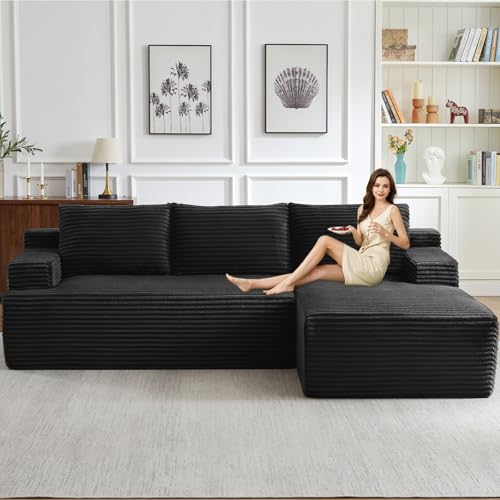
- Modular L-Shaped Flexibility: This 2-piece L-shaped sectional lets you freely rearrange it to fit your space—small apartments, open living rooms, or cozy nooks all work. Place it
- No Assembly – Ready Fast: Skip the setup hassle! Unbox the modular pieces, lightly tap each segment to fluff, and your couch is instantly usable. It’ll reach full, plump luxury
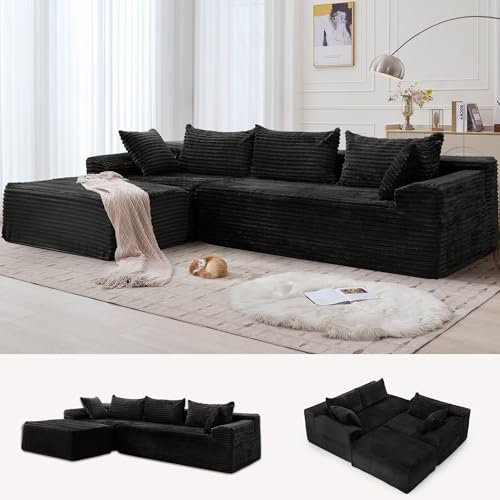
- Tool-Free Assembly & Ready to Use: Skip the hassle of traditional furniture—no tools, screws, or complicated instructions needed. This sectional sofa arrives vacuum-packed for
- Apartment-Friendly Size & Flexible Modular Design: Designed for small apartments, this modular sectional includes three lightweight, independent pieces that one person can easily
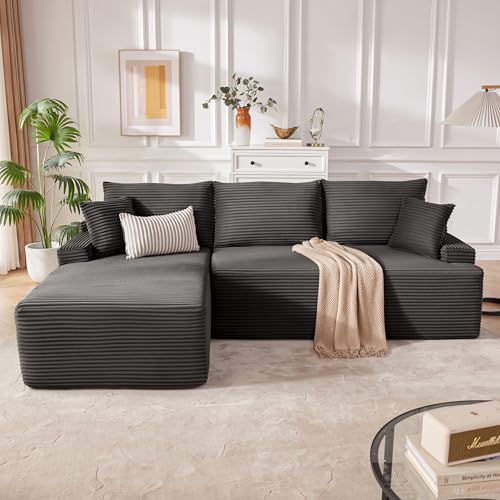
- Soft Corduroy Fabric: Upholstered in smooth, breathable corduroy, this Cloud Sectional Couch features an L-shaped chaise sofa design that blends comfort with quiet elegance. The
- Modular Flexibility: This modern modular sofa features a flexible design that can be freely rearranged into various configurations to fit your space. Whether you're furnishing a
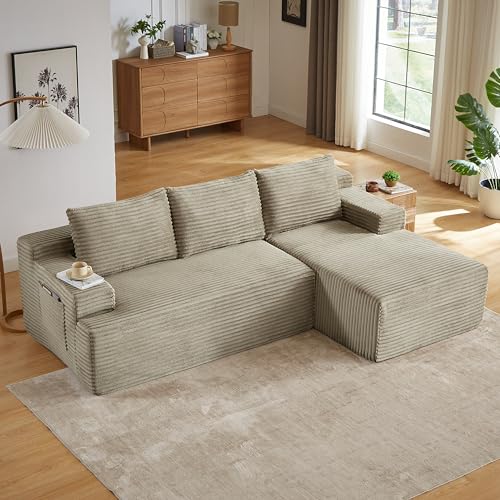
- Modular Flexibility for Endless Layouts :Design your space your way with this versatile 2-piece modular sectional. Featuring a reversible chaise and independent modules, it easily
- Sink-In Comfort with High-Resilience Support :Experience cloud-like relaxation without bulky frames. Filled with premium high-density foam and built-in coil springs, this boneless
Start with the tape measure, not the couch
The single mistake that ruins sectional purchases is buying by photo. A sectional that looks "normal" in a staged listing photo can eat an entire wall in a real apartment.
Do this before you look at a single product:
Finding the right how to choose right sectional sofa comes down to matching the features to how you will actually use it.
- Measure the wall the sofa will sit against. Your sectional's long side should take up roughly 60–70% of that wall. On a 12-foot (144") wall, that's about 86–100 inches.
- Measure the chaise runway. The chaise leg sticks out perpendicular. A 96" sectional typically has a chaise arm running somewhere in the 60–70" range into the room. Tape it out on the floor.
- Leave 30 inches of clearance for walkways, and 14–18 inches between the sofa front and a coffee table.
- Measure your doorway, hallway turns, and stairwell. This is the one people skip. Traditional framed sofas get stuck. Boneless, modular, vacuum-packed sectionals don't — each module ships compressed and separately, which is a genuine advantage in a walk-up.
What size sectional for a 12x12 room?
A 12x12 room is 144" x 144". Realistically you want the sofa's long side at 96" or less and the chaise depth kept tight, or the room becomes a hallway around a couch. The 96" models below are roughly the ceiling for that space. A 108" sectional will fit physically but will make a 12x12 room feel like a furniture showroom floor with no floor.
How big is a sectional couch, generally?
Sectionals in this category are sold by their overall long-side width. Common sizes run 84" (compact), 96" (standard apartment), and 108"+ (family-sized). Seat depth is the second number that matters and it varies more than people expect — a deep seat is lounging furniture, a shallow seat is sitting-upright furniture. Depths in the products below range from 27" to just over 51", which is an enormous practical difference.
Note: where a size isn't printed in the product data, it's marked "Not stated" — check the live listing, since sellers frequently update dimension tables.
Chaise direction: the decision people get wrong
"Right facing" means the chaise is on your right as you look at the sofa. Sit on the couch and it's on your left. Get this backwards and the chaise blocks a doorway or a TV wall.
Several of these are fixed right-facing — the GRUSIGN Cloud Sectional, the Lakifun 96", and the THSUPER 96" are all listed as right-facing. The Eafurn 96" lists a reversible chaise, and the Korser 108" ships as three independent modules with an armless seat that works as a standalone chair. If you're unsure about your layout, or you expect to move within a year or two, reversible or fully modular is worth more than the price difference.
Who a boneless modular sectional is for
- Renters and apartment dwellers. These ship vacuum-compressed in multiple boxes and require no tools. Modules are light enough to move alone — the Korser explicitly notes one person can move each piece.
- People with awkward access. Narrow hallways, tight stair turns, elevator-only buildings. A framed sofa is a gamble; compressed modules aren't.
- Anyone who wants to lounge, not sit. Deep seats with low profiles are for stretching out, movie nights, and naps.
- Families with kids or pets. Corduroy on all six of these is described as easy to wipe or lint-roll, and there's no exposed hard frame edge.
- Budget-conscious buyers. Everything here is under $300, which is a fraction of a traditional framed sectional.
Who should skip this style entirely
- Anyone who needs to sit upright. Deep, low, legless seating is hard to get out of and offers little lumbar support. If you have knee, hip, or back issues, or you want a sofa you can work from at a laptop for hours, buy a framed sofa with a firm 21–23" seat depth and a 17–19" seat height instead.
- People who want a piece that lasts a decade. Foam-and-fabric construction with no hardwood frame is a different value proposition. It's comfortable and cheap; it is not heirloom furniture.
- Formal living rooms. These read casual. In a room with a traditional or mid-century scheme, they'll look out of place.
- Anyone who can't wait. Every one of these requires a fluffing period — the GRUSIGN suggests 36–48 hours, the Korser 24–48 hours, and the Lakifun says up to 72 hours to reach full shape. Out of the box, it looks flat and wrong. That's normal.
The honest trade-offs
Comfort vs. support. Sink-in foam feels incredible on day one. Over time, foam-only seating compresses more than a spring-and-frame build. The Eafurn and THSUPER listings mention built-in coil springs alongside the foam, which is a meaningfully different construction than pure foam — worth noting if longevity is your concern.
Deep seats vs. usable room. A 51" seat depth like the Eafurn's is essentially a daybed. That's fantastic for lounging and terrible if you have short legs or want your feet on the floor. The THSUPER's 27" and the Korser's 30.08" are more conventional. Read that number carefully; it's the spec that determines whether you love or resent the couch.
Modular flexibility vs. staying put. Modules that rearrange also drift apart when people sit down. Some buyers solve this with furniture connectors or a rug with grip. Factor it in.
Multiple boxes. The GRUSIGN ships in two boxes and the listing warns they may arrive on different days. Plan for a partial delivery rather than assuming something went wrong.
What to check on the listing before you buy
Listings change constantly — specs, prices, and even which variant is default. Before you click buy:
- Current price. Prices here move week to week. What's shown is a snapshot.
- The exact variant. Color and chaise orientation are usually the same listing. Confirm you've selected right-facing vs. left-facing and the color you want before checkout.
- The dimension table on the listing itself, not the title. Titles round; the A+ content usually has real numbers for overall width, chaise depth, seat height, and back height.
- Warranty and return window. Compressed furniture is difficult to re-box. Find out whether returns require original packaging and who pays return shipping.
- Seller and shipping. Confirm whether it's fulfilled by Amazon or a third party, and check the stated delivery window.
- Recent customer reviews and photos. Go read them yourself — buyer photos are the most reliable way to see how a piece actually looks after the fluff period.
Consider instead if…
96" Modular Sectional Sofa Couches L-Shape Couch 3 Seat Modular Sofa Corduroy Memory Foam Sectional Boneless Couches for Living Room, Cloud Couch with Oversized Chaise(Black, Right Facing) — consider instead if…
…price is the deciding factor and you want a straightforward 96" two-piece L-shape. At $269.99 it's near the bottom of this group, and Lakifun states the fabric is stain-resistant and wipes clean with a damp cloth. Note the longer settling time: the listing says up to 72 hours to reach full shape.
96" Modular Sectional Sofa, Cloud Sectional Couch with Deep Seat, Modern L-Shape Corner Sofa Couch with Right Facing Chaise,Upholstered Boneless Couches for Living Room Bedroom — consider instead if…
…you want maximum lounging depth and layout freedom. Eafurn lists a 51" seat depth and a reversible chaise, so it converts to an L-shape, a daybed, or separate seating. It also lists a side storage pocket and extra-wide armrests. Skip it if you want to sit upright — that depth is built for sprawling.
Korser 108" L-Shaped Modular Sectional Sofa with Chaise, Boneless Comfy Corduroy Fluffy Couch with Deep Seat and Side Pockets, Flexible Module Combination for Living Room, No Assembly, Side Pockets — consider instead if…
…you have the wall space and want the largest footprint here. At 108" wide with a 30.08" seat depth and a 14" seat height, it's the family-sized option. It ships as three independent modules, and the armless seat works as a standalone chair. Too big for a 12x12 room.
96" Black Oversized Sectional Boneless Deep Seat Couch. Right Face Chaise — consider instead if…
…you want the lowest price and a more conventional 27" seat depth. THSUPER lists high-density foam with built-in coil springs, a reversible chaise, a side storage pocket, and wide armrests, at $233.10.
Mangodan Cloud Sectional Sofa, Boneless Couch for Living Room, Dark Grey — consider instead if…
…you don't want black, and back support is your worry. Mangodan lists an upgraded backrest with added bolster pillows for neck and shoulder support — a direct answer to the common complaint that foam sofas don't hold you up. It's the dark grey option in this group.
GRUSIGN Cloud Sectional Boneless Couches for Living Room, Modular L Shaped Couch with Deep Seat Oversized Right Facing Chaise, Memory Foam Compressed Spineless 3 Seater Sofa for Apartment, Black — consider instead if…
…you want memory foam specifically. GRUSIGN lists 30D elastic foam with 3D cutting technology and a 0.1-inch extra-long corduroy weave. It ships in two boxes that may arrive separately, with a 36–48 hour fluff window.
FAQ
How do I choose the right size sectional for my living room? Take the width of the wall it will sit against and target 60–70% of it for the sofa's long side. Then tape out the chaise leg on the floor and confirm you still have 30 inches of walkway. If the tape outline makes you step around it, go a size down.
What size sectional fits a 12x12 room? Stay at 96" or under. The 96" models here are about the practical maximum for that room, and you'll want the chaise pointing away from the door. A 108" like the Korser will fit but will dominate the space.
Do I need left-facing or right-facing? Stand where you'd enter the room and look at the sofa. "Right facing" means the chaise is on your right from that view. If you're not confident, choose a model with a reversible chaise, like the Eafurn 96", so the decision isn't permanent.
Why does it look flat when it arrives? These ship vacuum-compressed. The foam needs time to expand — the listings state 24–48 hours (Korser), 36–48 hours (GRUSIGN), and up to 72 hours (Lakifun). Pat each section and give it the full window before judging it.
Related guides
- Christopher Knight Evelyn Accent Chair Review
- Editorial Policy: How Plushseating Researches and Reviews Products
- Comparing Your Best sofas couches and living-room seating including sectionals loveseats recliners armchairs sleeper sofas accent chairs chaise lounges ottomans and futons Options
Key Takeaways
- Choosing the right how to choose right sectional sofa means matching the key features to your specific needs and budget
- Read real customer reviews and check the return policy before you commit
- Compare value across models — the priciest option is not always the best fit